We’re coming Iceland! (eventually…)

Helsinki Airport Finnair Lounge

Just a few days before we set off on a five-week cycle tour around Iceland – but first we have just one more leg of this oh-so-long-haul flight.

Let’s just say it’s been a long day. Or two days. Or however much time has passed since we left Sydney on Thursday and arrived in Helsinki (via Singapore) a little while a go. Air travel will do that to you. My ability to measure time has been reduced to episodes of US sitcoms and e-book chapters. 

Paul and I have now spread out and settled in for an eight hour wait at the Finnair lounge at Helsinki Airport. The luxury of hanging out in comfy chairs with reserved business people cost us almost 100 euros, but already that has been worth it for the shower alone, let alone the bottomless coffee cups, food and the reliable wi-fi – thank you very much. It’s apparently early in the morning here, and we board our flight to Reykjavik at about 3 pm this afternoon.

It was only last year that we made a pact to return to Iceland one day, during a stopover at the airport, and apparently we meant it.  After arriving in Reykjavik this afternoon, we will have a few days decompressing and exploring Iceland’s only city – before spending  38 days cycle touring and camping around the so-called ‘land of fire and ice’.

Of course we like to think we’re being original in our little adventurous stopover en-route to the UK, however one blogger we contacted for advice in preparation for the trip commented on how many other such emails he’d received recently. He called it the ‘Walter Mitty effect’ (something Icelandic tourism businesses have also noticed and of which they are taking full advantage). We’re not sure quite how big a role Ben Stiller played in our decision to cycle around Iceland, but I couldn’t discount it entirely for at least helping to spark our imaginations.

Saying that, however, inspiration also came from our wonderful friend (and talented photographer’s) own experience in the country, and even the novel Burial Rites by Australian author Hannah Kent; a fictionalised account of Iceland’s last execution.

You could also say we’ve been hanging out with the ‘wrong crowd’, so to speak (or in this case, of course, the ‘right crowd’, but I guess that depends on who you ask). For example, when you befriend a professional adventurer as inspiring yet disarmingly affable as Chris Bray – who, among other things, once walked across Victoria Island with a mate unassisted, and who is currently sailing through the Northwest Passage with his equally adventurous and amazing wife Jess – then suddenly something as relatively tame as cycling around little ol’ Iceland (which is roughly the size of Tasmania but definitely not mostly flat, as I have since learned – thanks Chris) seems suddenly achievable.

And so now here we are, almost – almost – there.

Our itinerary can be summed up as “in a clockwise direction”; our preparations as “all the gear and no idea” (there’s also, “learning on the job” and “Google”); and our physical training as “we both know how to ride bikes” and the all-important double-negative – “we aren’t not fit!”.

Iceland’s 1332 km Route 1 loop can be completed in as little as two weeks by fit, experienced cyclists in a rush – or so we’ve heard. However, we’ve allowed ourselves considerably more time than that, not just because we’ll probably need it, but also to explore the ‘side streets’, including the West Fjords and parts of the uninhabited interior, also known as the highlands.

We will pick up a couple of hired tour bikes in Reykjavik on 8 July and then hit the road with loaded panniers and hopefully diminished jetlag. Around five weeks later we fly out of Reykjavik to the UK where Paul will embark on a year-long furniture-making course in Devon, and where I will be working as a freelance journalist (but that’s a-whole-nother story, for another time). As for who we meet and what we find and experience during our time on the road in Iceland, your guess is as good as ours – which is how we like it.

I’ll be sharing our photos, thoughts and experiences from Iceland on this blog as regularly as possible along the way (internet access pending). You can receive email updates by entering your email address in the Follow field in the left-hand column on this page – we promise it will be less ruminations on long-haul travel, and more awesome photos like this (the only difference being our presence in padded lycra pants  – what more could you want?!)

Until then, takk for reading!
Elephant Nature Park

An overnight visit to the Elephant Nature Park – a sanctuary for domesticated Asian elephants – in Chiang Mai, northern Thailand.

This slideshow requires JavaScript.

During our honeymoon in Thailand, in March 2014, my (brand-new!) husband Paul and I visited the Elephant Nature Park in Chiang Mai in the country’s north, thanks to the sound advice of a wonderful friend (and US expat living in Bangkok), Anne Shifley.

It would have been so easy to tick a box and ride an elephant at one of the countless tourist parks, so we were immensely grateful that she pointed us in the direction of this magical place, where elephants are rescued from mistreatment, or taken in as orphaned calves or with injuries from land mines. There is no riding elephants at the park, instead visitors can feed and wash – or simply observe and learn about them.

We chose the overnight stay option (which included dinner – all vegetarian). I’d recommend this at a minimum for the opportunity to hang back after the day trippers have left and watch (and hear) the elephants as the sun sets over the surrounding forests.

South of the border

Throwback Thursday flashback to a guided tour of the North/South Korean Demilitarised Zone, back in January 2011.

DMZ 2011 messages of peace and reconciliation

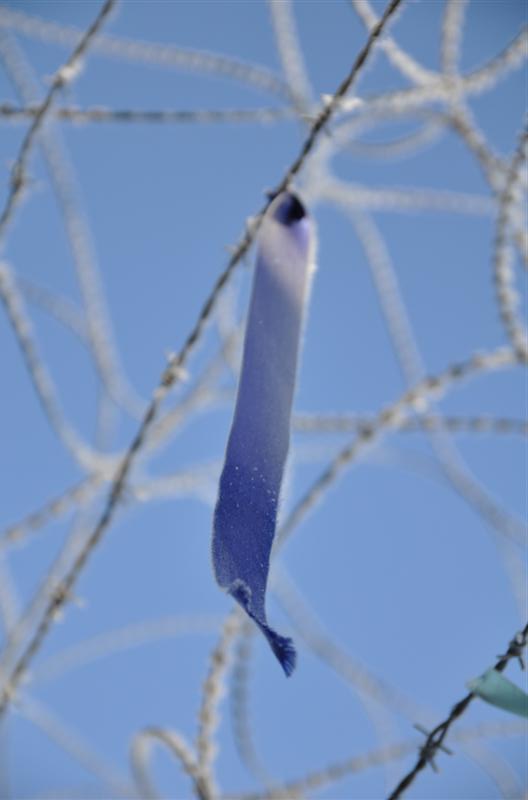
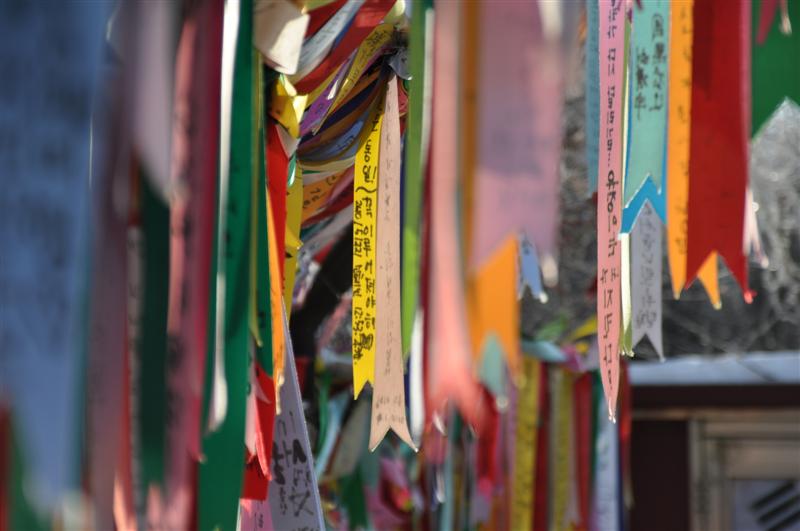
Messages of hope left by South Koreans for their kin beyond the border.

The bus windows were speckled with a flaky substance our bubbly tour guide explained was disinfectant spray to prevent the spread of foot and mouth disease. It hampered our view and sounded alarmingly carcinogenic, but we could still make out the white fields and surrounding hills she was in the process of telling us about.

“You can tell which hills are ours and which are theirs by the number of trees,” she said. “Theirs are bare, because they’ve chopped down all the trees for heating. They don’t have coal, like us.”

I hated to think of the North Koreans living through this winter in particular – the coldest South Korea had seen in 40 years, with temperatures as low as -17°C and only dropping as we trundled north in our tour bus. I wasn’t unique in this musing – whenever the weather turns bad in the south, the uncomfortable thought lingers in many South Koreans’ minds as their eyes flicker guiltily northward: How much worse must this be for them?

Enigmatic Seoul

Enigmatic Seoul, the capital of South Korea.

Forty kilometres south of the North/South Korea border, Seoul is a vibrant, enigmatic city. Vats of silk worm larvae from street food stalls waft pungent steam in the direction of westernised nightclubs and coffee houses.

Planning a stopover trip to Seoul from the safety of our home in Sydney, Australia, the idea of visiting its border with North Korea, also known as the Demilitarised Zone (DMZ), sounded a bit too risky, so we hadn’t included it on our itinerary. However, reality has a tendency to tilt on its axis when you arrive in a foreign country, and soon the idea of being within reach of the most secretive totalitarian regime in the world seemed too alluring to pass up.

In the rare event that a journalist sneaks footage from across the North Korean border (usually via its communist cousin, China), the product is stories and images of desperate and dirty-faced citizens, and the occasional appearance of Kim Jong-il’s (or nowadays, Kim Jong-un’s) smugly plump jowls. And when North Koreans do occasionally make it to the south (also usually via China), they take a long time to assimilate. This is generally because they speak and act as if they’ve come from a different era. They have never heard of concepts considered Western, such as jeans, or ‘diet’, our tour guide tells us. The direct translation of their old-world terminology for the latter, for example, is to ‘cut the flesh’.

DMZ 2011 tour bus passport check

Passport check on the way to the border.

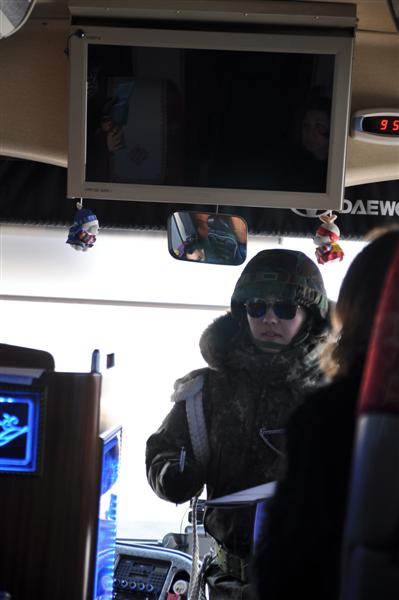
So I expect this day-trip to the DMZ to be tense, fraught with sadness and poignant, and when an armed soldier boards our bus to check passports (I managed to steal a photo before our guide nervously translated his clipped order that this was not allowed), it was exactly as expected.

Having successfully navigated our way through tank traps scattered across the road like a kid’s game of jacks, we arrived at the DMZ theme park (closed for the winter) complete with a frozen-over swimming pool and inoperative amusement rides.

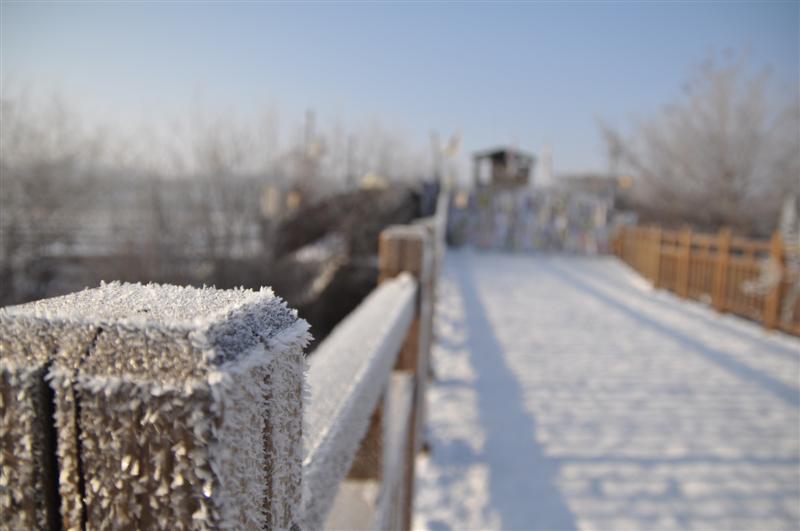
Bracing ourselves against the northern chill, we left the bus and followed our guide to the first tourist stop, the so-called Bridge of Freedom (also known, paradoxically, as the Bridge of No Return). This is the only bridge crossing the Imjin River and therefore connecting the north and south. It was here the two sides exchanged prisoners at the end of the Korean War, with the signing of an armistice in 1953.

The tourists milled gingerly around the ice-crystal-swathed bridge, shivering and eyeing each other sideways. Whitney Houston was belting “I-eee-I will always love you-ooo-uuu” over the PA speakers lining the bridge. The razor-wire fence at the end of the bridge was covered with colourful ribbons bearing Korean messages of peace and reconciliation to their long lost ancestors and family members on the other side.

DMZ 2011 theme park

‘DMZ Disney Land’ closed for winter.

The idea, I gathered, behind this bizarre dichotomy of quiet poignancy and, well, cheese at the tourist site was that, post-unification, the DMZ would be rendered little more than an historic monument to the bad-old-days. North and South Koreans alike could become teary-eyed to the vocal refrains of Céline Dion, and then enjoy a ride together on a merry-go-round. Instead this DMZ Disney Land gives a surreal, tawdry effect to a place that is otherwise one of the saddest I’ve ever visited.

Herded like school children into what I want to call the DMZ Discovery Centre, we shuffled through a museum of Korean War photos and educational displays, before entering a cramped cinema where we were shown a propaganda film. As the lights switched back on and curtains drew back over the screen, I had an uncanny sense of experiencing a Cold War I thought I’d been born too late for, but which never ended at this 250km-long by 4km-wide slash at the 38th parallel, separating two peninsulas populated by otherwise racially, culturally and linguistically identical people.

DMZ 2011 the bridge of freedom or no return

Sadly, the Bridge of No Return remains a more fitting name that the ‘Bridge of Freedom’.

Our final destination before being shipped back to the relative normalcy of Seoul was Dorasan Station, a modern train station in all its digitally timetabled, air-conditioned grandeur, bar one glaring absence: passengers. A couple of giggly tourists made snow angels near the unused tracks pointing north – tracks ready in every way, except politically, to transport imaginary commuters to Pyongyang. If it ever gets up and running, it will connect Korea to the rest of Asia and Europe – a backpackers’ rite of passage waiting to happen.

Adjacent to the train station was a small shop marketing the DMZ in a very unusual way – for its organic produce. Think about it: around 1000 square kilometres of fertile land relatively untouched (bar the odd land mine) for almost 50 years.

Albeit, after a breakfast of steamed silk worm pupae, the fruity biscuits we purchased were indeed tasty. The bottle of made-in-North-Korea soju (Korean vodka) was less so, but I’ve kept it as a memento of my weird trip into no-mans land. It serves as a reminder that, until things change, on the other side of that tacky border theme park exists an almost invisible population of suppressed, desperate people who are, among other things, fast running out of trees to burn for warmth.

Note: My husband, Paul, and I travelled to Seoul, South Korea, and visited the North Korean border back in 2011, which was when I originally wrote this piece.


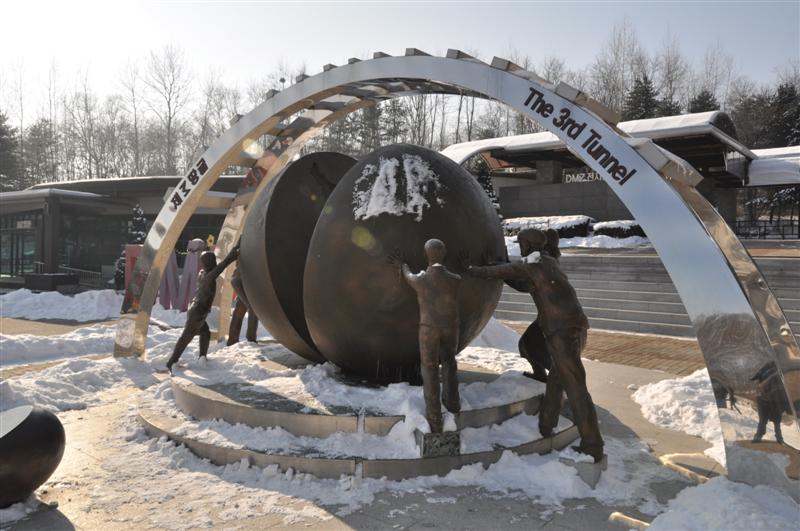
DMZ 2011 unification

Dreaming of unification.